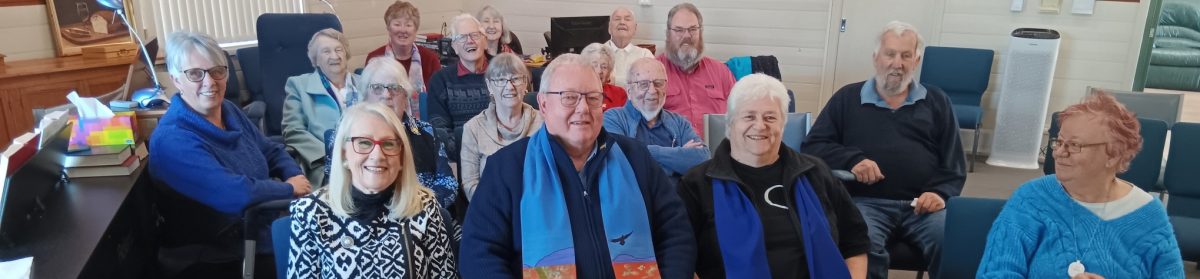
Deaconess Lorna Stevenson

Deaconess Lorna Stevenson (20 June 1922 – 19 September 2016)

Deaconess Lorna Stevenson (20 June 1922 – 19 September 2016)

Deaconess Lorna Nellie Stevenson was born on 20 June 1922 and passed away in Alice Springs on 19 September 2016.

Lorna trained as a deaconess at Rolland House in Melbourne and was ordained in the Presbyterian Church in Adelaide on 28 January 1960. She then worked as a field officer with the Christian Education Department of the South Australian Presbyterian church. She was an elder at Scots Presbyterian Church in Adelaide and a leader in combined Christian Young Adults group set up by the three churches long before they united.

Lorna went to Darwin in May 1969 as a deaconess in the Darwin Parish and in 1972 filled in at the Katherine Parish when there was a vacancy there.

Lorna was in Karratha in Western Australia with Frontier Services in 1973-74 serving with the Karratha Kamp team.

In 1976 Lorna travelled to Alice Springs and was a member of the Northern Synod Standing Committee from 1979 to 1982. She retained an active interest in the work of the Synod and frequently interrogated General Secretaries as to what was happening across our Synod and nationally.

After an overseas trip she acquired a brand new bright yellow car and moved into a new cottage at the Old Timers in 1980. Lorna maintained an active role in the local church. Every morning during the 1980s she was in the church office editing the weekly church bulletin, acting as secretary to the Centre Presbytery and was a member of a review team that visited the APY Lands. During this time Lorna also assisted in the ministry at Tennant Creek when there was no patrol minister there.

Up until her illness in 2016, Lorna would sometimes officiate at communion in the John Flynn Church if the minister was away, and took an active part in the small monthly services at Old Timers.

A long time friend, Eldrene March said of Lorna – she was a good thinker, a great typist and administrator which was a blessing to the John Flynn Church.

(Source: Peter Jones, General Secretary, Northern Synod).

Deaconess Marjorie Somerville 23Nov1920-30Sept2009

DEACONESS MARJORIE ALICE SOMERVILLE 23 November 1920 – 30 September 2009
Marjorie (Marj) Wilkinson Somerville was a double certificate registered nurse and deaconess, who, in 1946, pioneered the inaugural Methodist Nursing Services, establishing the nation’s first interstate mobile nursing service between New South Wales and Queensland.
When Marj moved to Noosa in 2007, she returned to public speaking and gave talks at bookstores and events. She was booked with speaking engagements on the Sunshine Coast until February. It was with sadness they were cancelled when Marj died in Buderim Private Hospital after a short illness.
With her colleague, Ethel Helyar, she brought a unique combination of free pastoral, medical and dental care to all, “regardless of class, colour or creed” as was their motto. In this capacity, Marj patrolled an outback region of 35,000 square miles in an ambulance fondly named “Augustus”.
As a much-loved “Methodist Sister”, Marj was called upon to assist bachelor graziers, lonely housewives, Aboriginal communities by riverbanks and townspeople. She established Christmas plays and country children’s camps to city beaches.
Marj, graceful and beautiful, was flattered by many romantic advances, but the cry of the suffering people was stronger than the longings of her romantic heart.
In 1949, when she left the outback for health reasons, Marj pioneered the first Methodist Nursing Service in Newtown, Sydney. As the infamous Coal Strike of 1949 heightened, her compassionate service to the poor, elderly and unemployed was frequently reported in newspapers. The Sydney press nick-named Marj – the nurse in the blue uniform – “the Blue Angel”.
Marj was an inspiration for the Rev Arthur Preston and Queensland pioneer nurse, Olive Crombie, who, in 1953, adapted Marj’s Newtown model for their inaugural West End Blue Nursing Service, adopting the same motto.
In 1951 Marj married and bore three children. In 2000, she was short-listed for Senior Australian of the Year. In 2006, the biography of her pioneering nursing life, “Angels of Augustus” was launched at Parliament House, Sydney.

Deaconess Lorna Latimer 27July1920-12March2009

DEACONESS LORNA LATIMER 27 July 1920 – 12 March 2009

Lorna was born on the 27th July 1920, in “The Cottage Hospital” Diadem Street Lismore. Her parents were Ethel and Arthur Latimer. She arrived into the world with three older siblings, Arthur 13 years her senior, Jack 11 and Winifred 9. Winifred told Lorna the story of how excited she was going to school the next day and telling everyone about her new baby sister.
Lorna attended Lismore Primary School in Keen Street and Super Primary in North Lismore. At the end of her schooling Lorna cared for her parents in the family home.
After her parent’s death Lorna now in her early thirties, candidated for Order of Deaconess in the Methodist Church. She was accepted and moved to Sydney in March 1952 to complete her training. When she was appointed to the position she travelled all over NSW country and coastal areas doing God’s work.
Lorna worked for 5 years in Central Methodist Mission with Rev Dr Sir Alan Walker, well known on radio and for services in the Lyceum Theatre and as founder of Lifeline. Lorna tells the story of being on the ‘Trouble Team for Lifeline’ and being called out of church in the Lyceum Theatre on a Sunday night to assist a caller who needed food. Lorna remarked she never felt disgruntled at the workload, and she always felt she could manage. She told me if you start thinking about yourself what’s in it for me, then it’s time to get out of it.
In all she spent 25 years as a Deaconess. Her position entailed assisting the Minister of the congregation and mostly doing the same work as a minister. Lorna remarked in those days women were not ordained as ministers. At other times in her life she held the position of House Mistress for the Methodist Ladies College, Burwood. She said she was glad to get back on the circuit because being House Mistress was not easy. On the circuit again took her to Molong where she helped the small Methodist Church join with the Presbyterian Church and to see the congregation get back on their feet.
In 1972 Lorna sailed around the world on the Greek liner Britannis for about five months. She travelled through the Suez Canal, around England, Scotland and the Scandinavian countries, down the west side of Africa and around the Cape of Good Hope. She had her 52nd birthday on the high seas on her way home to NSW Australia via Perth. She found that each country had its own beauty and charm.
When Lorna returned to Sydney the Church asked her to work at Orange in the Methodist Church. However her sister Winifred became ill and Lorna returned home to Lismore for seven months to care for her. When she was well again Lorna went back to Deaconess work at Menindee, near Broken Hill.
Lorna retired from Deaconess duties in 1977 at about age 59 years. She came back to Lismore and lived with her sister.
But Lorna didn’t really retire altogether as she worked in Jarman as an Assistant Supervisor for six years helping out with Worship Services, exercise classes, doing the medications and as cook and bottle washer. Jarman had the same number of residents in those days as it does now. Lorna retired altogether in 1984 at age 64.
Lorna came to live in Caroona Jarman on 29th April 1991 aged 70 years. Her brother Jack came to her rescue and made the next eleven years here in Lismore very happy.
Lorna never married and had no children of her own. These facts she said never worried her as she has always felt part of a close family. She loved and appreciated her siblings’ children. Their worries were her worries and she regarded them as her children. Arthur had 2 children, Jack had 4 and Winifred had 5 children. So Lorna experienced children growing up through her nieces and nephews. She spoke of her family as being ‘very family orientated’ and as ‘sticking together’ and ‘supportive of each other’.
Lorna explained to me that the Church and her faith in Jesus Christ is another dimension to her life. It has been her backbone and her strength. Her instructions to me were not to try to find answers for there are no clear answers but to simply have faith.

Ruth Hill

Original article by Helen Spelitis here.

RUTH Hill was only a baby when her father went away to fight in the Second World War but every night she kissed his photo before going to bed.

One night a man appeared at the front door.

Ruth’s mother rushed to meet him and said ‘better go easy with the children, you’re a stranger to them’.

Only Ruth knew all too well the man at the door was the same man whose photo she had been staring at each night.

“I came running through the house with my arms outstretched saying daddy,” Ruth said.

“I threw myself into his arms. He nearly fell down the stairs.”

Ruth Hill was born on September 10, 1943 and was the second woman ever to become a minister in the Presbyterian Church.

While she now lives at Rosewood, Ruth grew up in Brisbane.

Her family home in Mitchelton backed onto the train line and even now Ruth can remember the taste and smell of the mandarins that fell from the tree in their yard.

When Ruth finished school she moved into the nurses’ quarters at St Helens (Private) Hospital in South Brisbane.

She devoted four years of her life to learning how to care for others, yet never ended up working as a qualified nurse; love had other plans.

Growing up Ruth was always heavily involved with the Uniting Church.

When she was 13-years-old, a young minister came to speak at her parish and Ruth was inspired by his words.

“I said to my mother afterwards, ‘wasn’t he lovely? That’s the sort of man I want to marry one day’,” Ruth said.

“One day dear, my mum told me. And one day I did.”

When Ruth was 20-years-old the mysterious minister, named Kenneth, returned to the parish and the pair instantly clicked.

Nine days of courting followed and in a year they were married. It was about a week after Ruth finished her nursing studies.

“He didn’t propose as such, he told me,” Ruth said.

“I was thinking about going to Tasmania to study midwifery but didn’t feel quite right about it.

“Then I was talking it over with Kenneth and he said, ‘well you could stay here instead and we could marry at the end of the year’.

“I almost died. After a little while he said, ‘well, you haven’t answered’.

“I said well no, you haven’t asked me, so he did.”

A little more than a year after they were married Ruth fell pregnant.

She and Kenneth raised four babies, three boys and one girl but only the birth of the girl was straightforward.

“I was in labour for five days with one of them,” Ruth said. “I remember the doctor coming to see me at home to ask how I was. I told them I would be better if they took me into theatre, knocked me out and took the baby out of me somehow; and that’s what they did.”

Later in life Ruth studied to join her husband’s life work and become a minister herself; the second woman ever to take up the position.

She joined the hospital chaplaincy at the Wesley Hospital and spent her time sitting with patients, listening and comforting them in their time of need.

Two years ago Ruth and her husband Kenneth moved into Cabanda Care at Rosewood, a change in lifestyle they were both ready for and are enjoying.

Rev Jenny Busch

Speaking words of life and love
Meet Rev Jenny Busch, Uniting Church chaplain at the
Lady Cilento Children’s Hospital in South Brisbane.

This is holy ground and I am learning to walk tenderly and reverently in and out of rooms and families and situations. My prayer is that, somehow, my presence might remind people – sick children, family members, other visitors and staff – of the presence of Christ.

I am amazed how much I have grown spiritually since starting in the hospital in June 2016. I am drawn more fully to the life and power of Jesus to sustain my own faith and hope. While I join the families in hope and prayer for their children, it is my role to also assure them of the loving presence and power of Christ regardless of their immediate circumstances.

Although I felt called to serve at the hospital, which cares for children from across the state and even overseas, waves of panic would wash over me when I thought about some of the things I might see and experience. In my early days here, I would quietly and prayerfully walk through the Paediatric Intensive Care Unit, visually and spiritually preparing my mind and body for what God might ask of me.
The first time I received a call to do an emergency baptism of a dying infant, I found myself praying not only for them but for myself. Could I do this without crying?

But as I read the words of the baptism service and owned for myself again that Christians are baptised into the death and resurrection of Christ, I realised that while many others from the hospital that day were talking to this young mum and dad about death, I had the privilege of speaking into that situation of life in God. The baptism certificate, photos, candle and commemorative Bible will forever speak to this family, and to me, of the loving, eternal power of Christ.

Rev Deacon Jean Stirling


Pastoral Note from the SA UCA Moderator 2018

Dear Sisters and Brothers in Christ,

It is with deep sadness that I write to the Synod and Presbytery of South Australia to share the news that Rev Jean Stirling passed away on Wednesday 17 January 2018 at her home.

She was 76 years of age.

Jean has been an icon in South Australia, championing the role of Deacon in the Uniting Church.

At the age of 21 years, Jean experienced a strong sense of call and began Diaconal studies in Queensland. Health issues put her studies on hold, and she worked 11 years as Secretary to the Central Methodist Mission in Brisbane. In this time, she helped with the establishment of the Blue Nursing Service (now Blue Care), aged care homes, and a community centre at the Mission. Her secretarial gifts were put to further use when she moved to the Methodist National Memorial Church in Canberra. It was during those five years that the call to ministry came again.

She returned to Queensland and was the first to train for the Diaconate, alongside those preparing to be Ministers of the Word, at Trinity Theological College.

Jean’s first appointment as Deaconess was to Aitkenville Uniting Church in Townsville in February 1981, as part of the ministry team. As a Deaconess, she specialised in music and worship leading, began a healing group, and offered pastoral care to hospitals, aged care and to homeless girls.

In 1986, Jean was called to the Glenelg Parish in South Australia where she began a similar work, developing a College for Seniors. In this time she became the organiser of the meetings of the Diaconate in South Australia.

On 21 February 1993, Jean was accredited as a Deacon at St Andrew’s Uniting Church Glenelg, following the Assembly decision to accept the Ministry of Deacon as an ordained role within the Uniting Church in Australia. She chose to take the title Deacon, and could then conduct Holy Communion.

This opened the way to her appointment as the Coordinating Chaplain to the Helping Hand Centre at North Adelaide. Her chaplaincy was across aged communities at Parafield Gardens, Ingle Farm, Port Pirie, Barryne Retirement Village at Belair, and the independent living units in Prospect. She was also the minister to the congregation at the North Adelaide aged care complex.

Jean retired at the end of 2001, but kept a keen interest in the Diaconate and the life of the Uniting Church. Her astute mind, pastoral gifts of listening and patience, and her good humour ensured she made lasting friendships with many people across the life of the Church. She called the diaconate “a treasure given to the church”. Jean has been part of that treasure to the South Australian Presbytery and Synod.

Please join me in praying for her Queensland family, her sister Mrs Daphne Lomas and her brother Mr Bill Lindsay, and for those who were her extended family here in South Australia: the Brown family, the Helping Hand community, the South Australian Diaconal community, and members of Christ Church Wayville, where she worshipped.

A funeral service will be held for Jean at Christ Church Wayville (26 King William Road, Wayville). Details about this service will be provided in the Advertiser when available.

In Christian love,
Rev Sue Ellis

Moderator
Uniting Church SA

Reflections on DIAKONIA gatherings

Rev Bill Harris reflects on the rich experiences he had when attending a DIAKONIA conference in Europe, and then the World DIAKONIA Executive meeting. It really is a wonderful experience to see the breadth of diaconal ministry around the world, and to build relationships with Deacons and Deaconesses. Rev Bill Harris – reflections on DRAE & Exec Sweden 1998

DIAKONIA NEWS

The DIAKONIA News provides a broad scope of diaconal news from the DIAKONIA World Federation, and is published once or twice a year. Sandy Boyce is the English editor, who works with Ulrike Kellner (German editor) to compile the news. It is only published in electronic form.

DIAKONIA News 98-2012 (September 2012)

DIAKONIA News Edition 97-2012